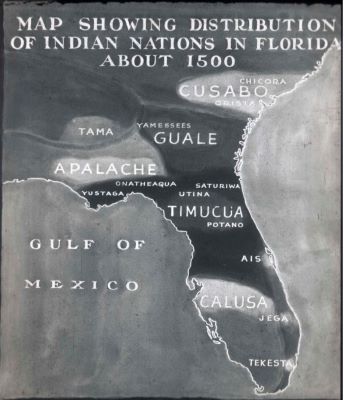
Many people believe that Florida was discovered by Juan Ponce de Leon over 500 years ago, but Native Americans have been living here a lot longer than any Europeans. In North Florida, the tribe that was in the area was the Timucuans. The tribe took advantage of the land and sea around them, becoming skilled farmers and fishermen. Even though we may now classify the Timucuans as one big tribe, they wouldn’t consider themselves a tribe. The Seminole tribe occupied the panhandle of Florida. They were formed from a group of Native Americans called the Creek Indians and runaway slaves. The Seminole Indians went through three wars against the United States. The Apalachee tribes were around for thousands of years until the arrival of Europeans. Like the Seminole, the Apalachee lived in northwest Florida. They were also known for a spiritual tribal sport which was thought to bring rain to the crops. The Calusa tribe was in South Florida, where they received the name the “Shell Indians”. The sophisticated people of the tribe were aware of how to deal with the political and social aspect of running a community. It’s thought that the tribe might be tied to the ancient people of South America.
TIMUCUA TRIBE
– National Park Service Website
They lived in the current day southern Georgia and Northern Florida. They practiced agriculture for their food sources but also hunted and gathered to obtain food. Important crops to the farmers were pumpkins, cucumbers, peas, gourds, maize, beans, and other fruits and starches. They also gathered hickory nuts, berries, and acorns. Being on the Florida coast, the Timucuan diet consisted of many fish and seafood. “They were skilled at building canoes to catch fish. The fat from the fish was as oil in sauces. Oysters were also readily available to the tribes and easy to catch and cook. They would stack oyster shells and other food trash stacked generation after generation in the same mounds.” (The Timucua: North Florida’s early people) They spoke their own dialects of some of the same language. However, the Timucuans were not united politically, which led them to have different tribes with their own territories. The Timucuans wouldn’t have seen themselves as one people like we might see them today. When it came to spirituality, they would worship the sun and moon but also had other gods of importance. The group’s chief held the most religious power, and they were called shamans. The shamans could predict the future, curse people, control the weather, perform blessings, and cure people. During the winter, the Timucua left their villages to go live further into the woods. The Timucuans occupied over 19,000 square miles of land and had a population of around 200,000 when the Europeans first arrived in the 1500s. But of course, what happened to all the other tribes in North America also happened to the Timucuan. By the 1800’s there were few Timucua left, and survivors were taken in by other tribes like the Seminole and Muscogee Creek. The clothing shocked the French because when discovered in the summer, the men wore loincloth wrapped around their waist, letting them quickly go in and out of the water. The women wore something similar but also wore deerskin or Spanish moss tops. During the winter they would add layers to their clothes rather than replacing them. Both males and females alike had tattoos, which was a status symbol. The more they had the more status they had. Necklaces and bracelets were made from shells and pebbles. The leaders of the tribes and their wives would dress differently than everyone else, which would be more intricate and have ornate designs painted on them. I think it’s interesting how the lasting effects of the Timucuan can still be viewed today not only at the Timucuan Ecological and Historic Preserve but also how people in the North Florida area still function today. People have learned from the past and still use certain techniques when it comes to farming, fishing, or hunting in the area. I also think it’s sad how the Timucuan people lost not only their traditions but their community. Today, the Timucuan’s story can be told at the Timucuan Ecological and Historic Preserve.
SEMINOLE TRIBE
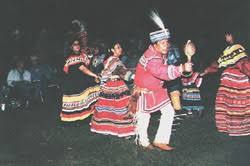
– Florida Department of State – Seminole History
Known as the “Unconquered People”, the Seminole tribe formed from a band of Creek Indians from Georgia and Alabama, who migrated to Florida in the 1700’s. They moved due to conflicts with other tribes and Europeans, causing them to seek new lands to live in peace. It wasn’t till the 1770s that the Florida Indians collectively became known as the Seminole, a name meaning “wild people” or “runaway. By the 1800’s, white settlers decided they wanted the Indian land. “This would escalate to the first of three Seminole wars against the United States. At the time future president, Andrew Jackson, invaded then-Spanish Florida, attacking center locations that sent the Seminole further into South Florida.” (Florida’s early American Indians) The second war began after the passage of the Indian Removal Act in 1830 when the U.S. government tried to relocate the Seminoles to Oklahoma. Their leader Osceola was captured by the United States in 1837. He soon died afterward in Fort Moultrie near Charleston, South Carolina. He was born in a Creek Indian Village in now eastern Alabama. After his death he won widespread respect, even having several towns and counties named after him. After the end of the third war, more than 3,000 Seminoles moved west of the Mississippi River, leaving around 200 to 300 remaining in Florida, hidden in the swamps. For two decades, the Seminoles weren’t seen until trading posts became a thing in the 19th century at places such as Fort Lauderdale and Chokoloskee. It wasn’t till the late 1950s when the Indian tribes organized themselves and created their own charter because of federal legislation that allowed Indian reservations to act as their own separate entity from state government. So, in 1957, tribal members voted in favor of a Seminole Constitution, which was established at the federal level as the Seminole Tribe of Florida. I find it very interesting that the Seminole tribe was made up of another tribe. Making it where the group was just one select group of people, it was different types of people coming together to form one tribe.
APALACHEE TRIBE
Apalachee Women – Florida Department of State
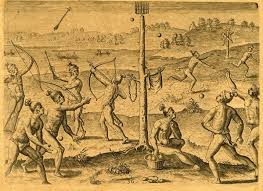
Since A.D. 1000, a tribe of farming Indians known as the Apalachee lived in northwest Florida. Their territory extended from now the Georgia state line to the Gulf of Mexico. Before the Europeans came to the area there were over 50,000 Apalachees. They were prosperous and fierce warriors which made the tribe well respected. As part of their necessary agriculture, the tribe cultivated corn, beans, and squash, with the men preparing the soil and irrigation and the women tending the fields. To ensure rain for the crops and as a religious experience, the Apalachee had a cultural tradition of playing a ball game. Villages would challenge one another to a game, and with two teams there would be around 100 players on each team. The ball for the game would be made from a clay ball covered with buckskin. The players would throw the ball with their feet toward the goalpost, which was a pole topped with a stuffed eagle nest. The men of the tribe also hunted bears, deer, and small game, while the women would gather nuts and berries. The clothes worn by the tribe consisted of deerskin loincloths and Spanish moss skirts which all came from reusing their resources. “As many of their cultural counterparts had done, the Apalachee constructed large ceremonial mounds with dwellings at the top for the chiefs and religious figures, with it being believed that the chief would live on the largest mound, and the smaller mounds were for lesser figures within the tribe.”( History of the Apalachee Tribe ) The Apalachee were one of the first groups of Native Americans to encounter European explorers, however like many tribes, the Apalachee were ravaged by diseases brought by the Europeans resulting in cultural decimation. Similarly, as with other tribes, the catholic missionaries sought to convert the Apalachee by any means necessary. The forced conversions and foreign disease led to approximately only 300 descendants alive today. Most descendants currently live in Louisiana and are seeking state and federal recognition as the Talimali Band of the Apalachee Indians of Louisiana. The Apalachee is the first recollection of sports we can see in the Americas. I find it interesting how they took something entertaining and turned it into something spiritual. This way they weren’t just connecting with one another but they were also connecting to their Gods and doing what they thought best for the survival of their community.
CALUSA TRIBE
–National Park Service Website
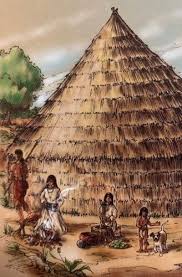
The Calusa tribe, known as the “Shell Indians” was in south Florida, just north of present-day Naples. The population reached 50,000 people. This tribe is considered a sophisticated people because of their political, social organization, and developed elaborate trade networks. The Calusa tribe is considered expert wood carvers, with great artistic skill which can be seen in items recovered from a Calusa site in Key Marco. “Their civilization was very similar to the ancient people of South America in how they grew maize, which has led some historians to believe that the ancient people of South America migrated to South Florida through the Antilles Islands of the Caribbean.” (The Calusa: “The Shell Indians.” ) The Calusa men were tall and had long hair. They lived in homes on stilts and used Palmetto leaves as roofs, but they didn’t construct any walls. Unlike other tribes, the Calusa made nets to catch mullet, pinfish, pigfish, and catfish. The women and children learned to catch shellfish like conchs, crabs, clams, lobsters, and oysters. Because of this, the Calusa were considered the first “shell collectors”. But unlike others, they didn’t use pottery as r tools, utensils, jewelry, and ornaments they used shells. They also used shells for spears made for hunting and fishing.
All four of these tribes got to survive off of Florida’s ecosystem. They used Spanish moss that grew in the trees, they got to eat oysters out of the rivers and oceans, and some even ate Alligators. They all developed their own names like ” The Shell Indians” and “Unconquered People”. As a native Floridian myself, I have realized how lacking we are in this knowledge. In the Florida public school system, I wasn’t taught any of this history. The Native Americans of Florida faced tragedy like the others all around the United States. They were forced to forget their traditions or be punished, convert to Catholicism, and forced to leave their land so that the Europeans could have it. Today, Native Americans still don’t get treated like all the other races in the United States. They live in poverty and still face hardships. Hopefully, by being informed and learning about these tragedies, they won’t ever happen again.
BIBLIOGRAPHY
U.S. Department of the Interior. (n.d.). The Timucua: North Florida’s early people. National Parks Service. https://www.nps.gov/timu/learn/historyculture/timupeople.htm#:~:text=The%20Timucua%20were%20a%20group,their%20own%20territory%20and%20dialects.
Kite-Powell, R. (2023, April 17). Florida’s early American Indians. Tampa Bay History Center. https://tampabayhistorycenter.org/blog/floridas-early-american-indians/
Seminole leaders. Florida Department of State. (n.d.). https://dos.fl.gov/florida-facts/florida-history/seminole-history/seminole-leaders/
Coastal and Marine Laboratory. History of the Apalachee Tribe | Coastal and Marine Laboratory. (n.d.). https://marinelab.fsu.edu/marine-ops/apalachee/history-of-the-apalachee-tribe/
The Calusa: “The Shell Indians.” The Calusa: “The shell indians.” (2002). https://fcit.usf.edu/florida/lessons/calusa/calusa1.htm
 Through Anna's Eyes
Leave a comment