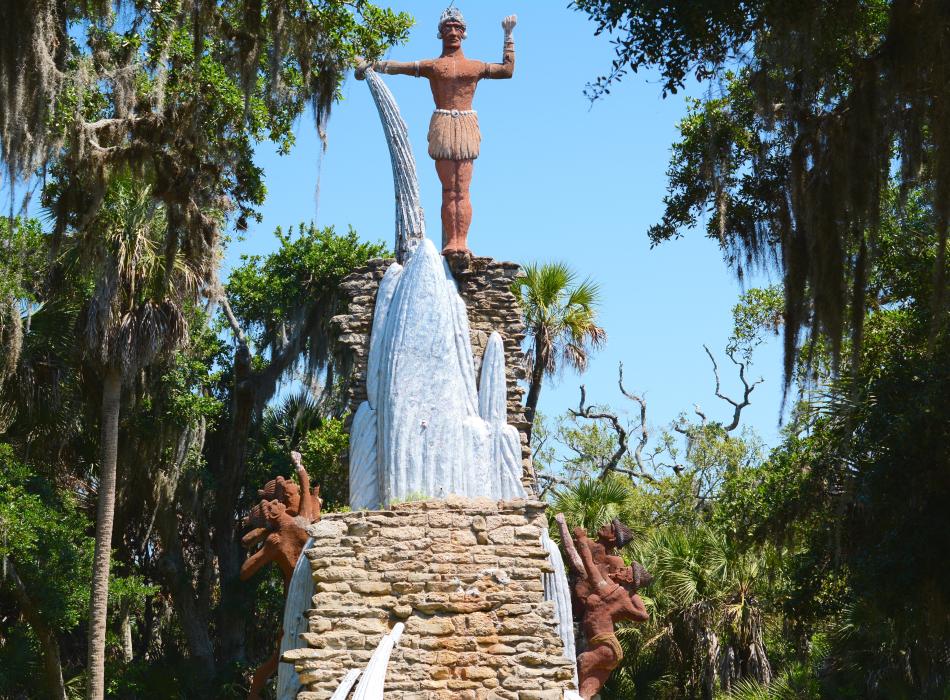
The Timucua were a Native American tribe that once lived in current day southern Georgia and Northern Florida. Often regarded as North Florida’s early people having lived in the region for centuries before Spanish explorers arrived in the early 1600s. The Timucua had rich cultural heritage and were the largest Native American group in the area. The tribe consisted of 35 chiefdoms, which spoke several different dialects of the Timucuan language.
LOCATION
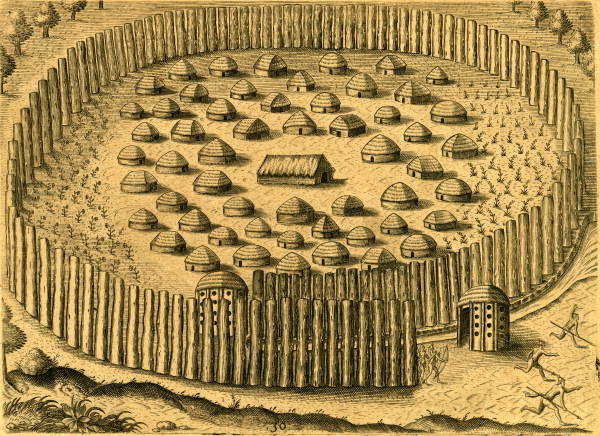
The Timucua tribe lived in current day South Georgia and North Florida, occupying about 20,000 square miles of land with and estimated population of 200,000 people. With 35 chiefdoms or separate villages, each with a few hundred people living with in.
The towns that the Timucua lived in consisted of small huts made from palm fronds and compacted mud. The chief would live in the largest house than other people in the tribe. Other buildings consisted of a community house, where important community events were held. There was also a storehouse, where the food was stored, and huts where women stayed right after giving birth.
CULTURE
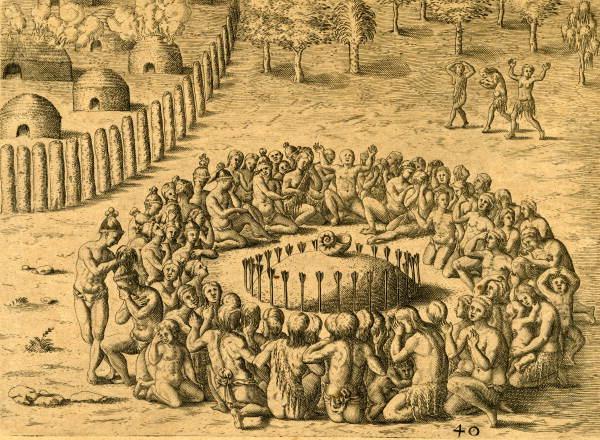
The culture of Timucua was distinct from the foreign European cultures that explored the land. Leaders and their wives dressed differently than everyone else, wearing more intricate clothes with ornate designs painted on them. The chiefs wore their own distance face paint designs, and their wives often painted the skin around their mouths blue. Both male and female had tattoos, which was a status symbol throughout the tribe, and the more tattoos someone had the more status they had in the tribe. Their face was painted daily with black face paint.
The language of the Timucua is something that was heavily recorded by the European missionaries. Each different village in the Timucua tribe had their own dialect making each one different. Other aspects of the culture emerged through the study of language, allowing for the understanding of which concepts were spoken of with respect and which complex concepts had words assigned to them.
RELIGION
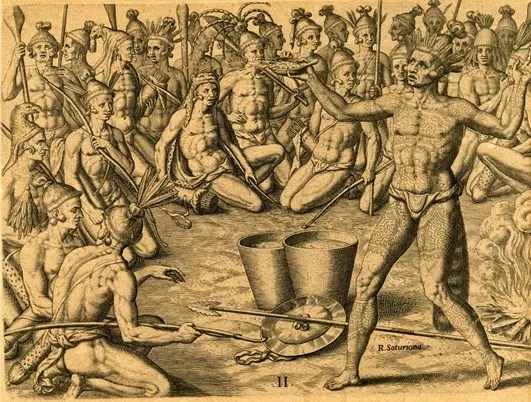
The Timucua people kept many of their beliefs secret from the Europeans, but what we do know is that they worshipped the sun and the moon. The chief held the most religious power, and certain members had more religious power than others. These Timucua were called shamans who could predict the future, curse people, control the weather, perform blessings, and cure people. The shamans were also doctors and herbalists and would use the plants around them to help people. Their beliefs about medicines and their gods could not be separated.
The Shamans were also involved in every part of daily life, from planting crops to helping with childbirth. They performed blessing over simple task like choosing fishing spots and turning maize into flour. The Timucua also believed in omens, meaning they interpreted random events to have a deeper meaning about the future. The hoot of an owl meant that something harmful was coming or that something bad would happen, but the owl took pity on the person who heard the hoot, and they were safe from the tragedy coming.
FOOD AND CLOTHING
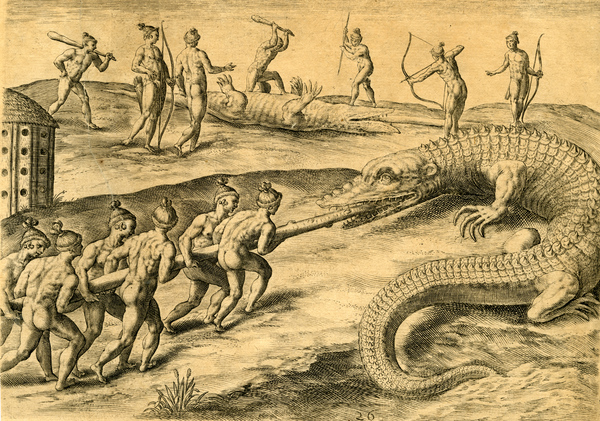
When first spotted by French explorer Rene Laudonnière, he reported that the Timucua had dark hair, light brown skin, and taller than the average Frenchman, which is shorter than the average person today. The men wore loin cloths that wrapped around their waist, and the women wore something similar, as well as a chest covering usually made of deerskin or Spanish moss. During the winter months, the Timucua added layers to their clothing rather than replacing them. They also wore jewelry, consisting of necklaces and bracelets made from shells and pebbles. They wore earrings that were made from used fish bladders and warriors decorated themselves with feathers, belts, anklets, and bracelets.
The Timucua grew a lot of their own food such as pumpkins, cucumbers, peas, gourds, maize, and beans. They gathered hickory nuts, berries, and acorns. They only grew enough food for about six months of the year. The tribe also fished and hunted, with fish and seafood was a major source of protein. They also hunted large game like deer and alligators, which yielded meat and pelts. Oysters were easy to catch and simple to cook. Oyster shells and other kinds of food trash were stacked generation after generation in the same mounds.
FOREIGN EXPLORERS
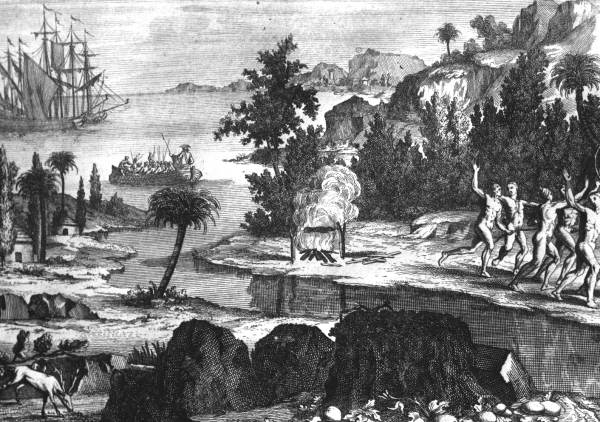
Europeans arrived in Florida in the 1500s, with the Timucuan being the first American Natives to have seen the landing of Ponce De Leon near St. Augustine, Florida. Although the tribe was known as one of the more peaceful tribes, they would fight back when pushed. But the war with the English decreased the numbers of the tribe. The population shrunk by 75% due to epidemics of new infectious diseases introduced the Native Americans by Europeans. As the tribe died out, they joined other neighboring tribes like the Seminole and Muskogee Indians.
CONCLUSION
In conclusion, the Timucua played an important role in Florida’s history. While the tribe may now be extinct, it’s important to remember the influence they still have today.
BIBLIOGRAPHY
Arrival of the Spanish at a Timucua village. 1562. State Archives of Florida, Florida Memory. Accessed 5 Nov. 2024.<https://www.floridamemory.com/items/show/33595>
Bry, Theodor de, 1528-1598. Construction of the Fortified Towns among the Floridians. 1591. State Archives of Florida, Florida Memory. Accessed 5 Nov. 2024.<https://www.floridamemory.com/items/show/254322>
Bry, Theodor de, 1528-1598. Killing Crocodiles. 1591. State Archives of Florida, Florida Memory. Accessed 5 Nov. 2024.<https://www.floridamemory.com/items/show/254215>
Bry, Theodor de, 1528-1598. Ceremonies at the Death of a Chief or of Priests. 1591. State Archives of Florida, Florida Memory. Accessed 5 Nov. 2024.<https://www.floridamemory.com/items/show/254312>
History of the timucuan. Florida State Parks. (n.d.). https://www.floridastateparks.org/learn/history-timucuan
U.S. Department of the Interior. (n.d.-f). Timucuan ways of life. National Parks Service. https://www.nps.gov/timu/learn/timuwaysoflife.htm
U.S. Department of the Interior. (n.d.-f). The Timucua: North Florida’s early people. National Parks Service. https://www.nps.gov/timu/learn/historyculture/timupeople.htm
Timucua University of South Florida. The timucua. (n.d.). https://fcit.usf.edu/florida/lessons/timucua/timucua1.htm
 Through Anna's Eyes
Leave a comment